Loading...
Loading...

The first major attempt to tell the history of a country on television -- from its first beginnings to the present day. Since the late 1960s we have all grown used to the suffering and violence in Northern Ireland. But these are just the latest events in an old story that began 800 years ago when England first became involved with Ireland -- whose first inhabitants had arrived there 8.000 years before.
1980
Robert Kee surveys the different races of invaders that, over the centuries, have gone to make up today's Irish people - from the stone-age men to the coming of the English and the Scots - and he asks if all these races can ever be 'a nation once again'.
With the flight of the last of the Gaelic earls from Ulster at the beginning of the 17th century, thousands of English and Scottish Protestants settled on land that had belonged to the Catholic Irish. The events that followed are remembered to this day by Catholics and Protestants alike: Cromwell at Drogheda; the massacre of Protestants by Catholics in 1641; the siege of Derry by King James II's Catholic army, when the cry of 'No surrender' was first heard. By the end of the century and the victory of William of Orange at the Battle of the Boyne, the seeds of sectarian division had been planted.
In the 18th century Ireland was virtually two nations. A new breed of nationalists, the United Irishmen, worked to bring the two nations together and plotted, with French help, to set up an independent Irish Republic embracing Protestants and Catholics alike. But the national rebellion degenerated into a bloody sectarian revolt. By 1801, with Britain and Ireland united, Catholics were not represented in the merged Irish and Westminster parliaments. Daniel O'Connell fought for and won Catholics' right to sit as MPs before embarking on a campaign to repeal Union.
Nearly a million men, women and children died in the great potato famine which devastated Ireland; another million emigrated, mainly to America. The British Government's attempts to help proved largely ineffectual. Thus sown were the seeds of a deep and lasting bitterness toward the British, which was to have a profound effect on the later development of Irish Nationalist feeling. Through the words of eyewitnesses, an account of this watershed in Irish history.
A secret organisation known later as the Irish Republican Brotherhood planned rebellion in the 1860s. Money and support came from Irish immigrants in America. But the Fenian rebellion of 1867, a series of uncoordinated and spasmodic uprisings, ended in total failure. Yet the story of the Fenians was to capture the imagination of future generations and inspire the nationalists of the 20th century. The Fenian tradition lives on in today's IRA.
No man ever disturbed British democratic politics so profoundly as Charles Stewart Parnell. He raised Irish national political feeling to the most effective level it had ever achieved, and no British Prime Minister could rule without taking Parnell into consideration. His rise was meteoric; his fall equally so. Overnight he lost his power in one of the greatest sexual scandals in the history of politics.
In 1914 after 30 years of opposition to Home Rule, the Ulster Unionists brought the UK to the verge of civil war in defiance of a Home Rule Act that would have put Ulster under an Irish national parliament in Dublin. The Unionists took as their slogan 'Ulster will fight and Ulster will be right'. As Irish nationalist feeling revived, opponents and supporters of Home Rule both ran guns into Ireland. Conflict was only averted by the outbreak of the Great War.
Tens of thousands of Irishmen enlisted in the British Army to fight, as they thought, for the rights of small nations like Belgium or even Ireland. Then, on Easter Monday 1916, a small group of Irish nationalists took over the General Post Office and other strategic sites in the capital and proclaimed an Irish Republic. Five days later, the centre of Dublin was in ruins and the Rising was over. Its leaders were executed. This is an account by eyewitnesses on both sides of the Easter Rising, its putting down and the executions that followed.
In 1918 Sinn Fein, pledged to an independent Irish Republic, won a sweeping victory at the first British General Election since the war. Irish nationalists set up a parliament of their own in Dublin. The scene was set for violent confrontation between British forces and the newly-created Irish Republican Army. Terror, as participants on both sides now recount, was answered by counter-terror. By 1920 Ireland had become a grim battleground. By 1921, British public opinion, the IRA and the British Army being equally exhausted, a truce was signed.
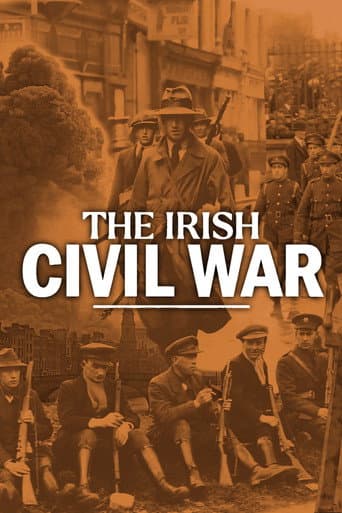
The Anglo-Irish Treaty of 1921 gave Ireland dominion status as the Irish Free State, and the six counties of Northern Ireland the right to opt out. Die-hard Republicans of the IRA considered the treaty and its oath to the King as head of the Commonwealth a betrayal of all they had fought for. In defiance they occupied the Four Courts in the centre of Dublin; the Free State army opened fire with guns borrowed from the departed British. Fighting spread from the streets to the countryside. The brutal civil war that followed divided families and southern Ireland through the present day (1980).
Civil War divisions continued to dominate politics in the Free State. After ten years Eamon de Valera, on the losing Republican side, eventually came to power with some help from the IRA. Soon he had to declare the IRA illegal. In 1937 a new constitution dropped the oath to the King; laid claim to all 32 counties of Ireland; and gave the Roman Catholic church a 'special position'. In the Second World War, Eire - as she was now called - remained neutral. In 1949 Eire left the Commonwealth and declared the Republic of Ireland. The new Republic's first political crisis confirmed northern Protestant fears of what a united Ireland might mean to them.
From its foundation in 1921, the new Protestant state of Northern Ireland proclaimed its loyalty to the UK, protected by the armed Royal Ulster Constabulary and 'B' Special Reserves against internal and external threats. The minority Catholic and Nationalist population suffered widespread discrimination for nearly 50 years. In the late 1960s, the frustration of Catholics boiled over. Civil rights marchers were batoned and stoned by Unionist mobs. The British Armv was sent in to protect Catholics but killed 13 Catholics in Derry on Bloody Sunday. After more terror, Westminster imposed direct rule on Northern Ireland. A Protestant general strike defeated an attempt at sharing power between the two communities.
Ireland's past has formed Ireland's and Northern Ireland's present (1981). Eire still seeks the unity of all Ireland; the Protestant North still resists; Catholics in Northern Ireland are still disaffected; Britain is still involved. A decade of violence in which more than 2,000 have been killed has only hardened attitudes, though politicians still work for a union of hearts and minds, or at least agreement to differ and to live in peace. There are few signs of movement. Both in the heartland of the Northern Protestant majority and in the Catholic communities they surround, there are those who see themselves as prisoners of history. Need they always remain so?
Streaming availability information not available