Loading...
Loading...

A weekly arts-based documentary series covering a diverse variety of subjects, everything from Roman orgies and the Elgin Marbles through The Yardbirds and Ike Turner to Aleister Crowley and Mother Teresa.
1992
A study of the life and career of the actor Sid James, best known for the long-running Carry On series of bawdy British film comedies.
Looking at the career of child star phenomenon Macaulay Culkin and how he compares to other child actors of the past and present.
Rory Bremner argues that having set herself up as a satirist on suburban values, Dame Edna now personifies the same values that she once abhorred.
Terry Eagleton critiques poet Philip Larkin. Larkin is considered a darling of the post-war British poetry scene. Terry Eagleton accuses him of being racist, emotionally stunted and lugubrious.
1991
A documentary that looks at the escapist world of hotels and boarding houses.
Robert McKee dismisses Orson Welles film, Citizen Kane as a mish-mash of stylistic excess and clichéd content.
A tribute to the long-running cult 1960's spy adventure series.
Russell Davies questions Laurence Olivier's position as the pre-eminent actor of our times.
Looks at the cult of the Radio1 DJ. Links from Mike Smash (Paul Whitehouse) and featuring Tony Blackburn, Gary Davies, Mike Read and Dave Lee Travis.
1990
A celebration of the satellite dish, looking at their history and considering the prospects for designer dishes.
Trial of the book and the acquittal of Penguin Books ushered in the freedom of the Sixties. With dramatic reconstructions this programme recreates the atmosphere of the time and tells the story of Lawrence's lifelong battle with the censors.
Paul Morley looks at prisons, historic and new, and at the "interior design" practiced by prisoners within their cells.
The mutual mistrust between the French and the English goes back centuries. A British television team looks at the way the French are adjusting to a world in which many of their ideals - revolution, patriotism and national culture - seem to be increasingly irrelevant.
A French television team looks behind the stereotypes and asks what the public role of British intellectuals is at a time when the channel tunnel is forcing the two societies together.
Inspired by the footballer, Paul Gascoigne, this documentary with music from Smokey Robinson and Sydney Devine, looks at men in tears - in art, pop, music, sport, the cinema and politics.
Rock critic Sean O'Hagan argues that the Rolling Stones are a burnt-out collection of middle-aged men who have failed to mature or find a late style. He also suggests that they have become the opposite of much of what they once stood for.
Paul Morley looks at Christmas decorations. Why do we want them? What do they mean to us and what do they say about us? How do the stores entice us to buy them? Do they offer a taste of a traditional Christmas or plastic nostalgia for a non-existent Golden Age?
Looking at the Royal Ballet's film started in the 1960s and left unfinished.
Looks at the hype behind the Mozart bicentennial celebrations.
Examines the ideas of Martin Bernal set out in book Black Athena (1987) in which he argues that the Wests view of Greek civilization has been distorted to promote the Aryan model to the detriment of black African and Semitic cultures.
Streaming availability information not available
1994
An appraisal of cultural icon, Alf Garnett (played by Warren Mitchell in the TV series Till Death Do Us Part and In Sickness and in Health).
1993
'Margaret Rutherford' (Tim Spall in drag) tells her life story in cabaret form before an audience.
1995
The spoof arts magazine show presents a drama exploring the short cuts television takes in its treatment of art. Lucrezia Borgia, one of the most glamorous women of Renaissance Italy, discusses her role as patron of Italian art.
Allison Pearson criticizes the news values of the BBC and ITN, saying that they are trivial, sycophantic and and prisoners to new technology.
Christopher Hitchens investigates whether Mother Teresa of Calcutta deserves her saintly image. He probes her campaigns against contraception and foeticide and her questionable relationships with wealthy religious and political leaders.
A documentary on the life of actress Carol White, the lead in the 1960s BBC drama 'Up The Junction'.
Jonathan Meades attacks the myths and culture surrounding vegetarianism.
Five performances by the Royal Ballet in Kenya in aid of elephant conservation.
The Reduced Shakespeare Company's interpretation of Wagner's Ring Cycle, compressing 16 hours into 30 minutes.
About the mid 20th century Tiki craze that captivated America, encompassing Polynesian themed bars and imaginative libations, a whole genre of music called exotica, and even an architecture, art, and design, all aptly described as Polynesian pop.
Germaine Greer launches an attack on the cult of youth. She argues that the obsession with youth has led to a morbid fear of aging at a time when old people outnumber the young.
Documentary. Tony Parsons investigates the controversy surrounding the film 'A Clockwork Orange'.
Ice-T Looks at the history of 1970s Blaxploitation cinema and its continuing influence.
Jerry Sadowitz presents a history of swearing on television.
Camille Paglia, a lesbian academic, looks at how lesbianism has become chic. She traces its history, from the writings of Sappho to the recent lesbian culture.
An examination of Proust's fascination with sex and food with a look at the psycho-sexual history evoked in 'Remembrance of Things Past'(A La Recherché Du Temps Perdu).
Tony Parsons delivers an essay on the state of the sex war, he suggests that there are some things that women do better than men: weeping, shopping and housework.
Janet Street-Porter takes the Internet to task, claiming its main use is to provide an occupation for boring, inadequate and socially inept people.
American film critic, Joe Queenan, adopts the persona of a male film star to assess his contribution to the cinema.
There are over 50,000 words of slang in common usage today. Lexicographer Jonathon Green points out that most of them come from sex, drugs and music.
Nabil Shaban argues that disabled people are misrepresented by Hollywood, the bad guy always being portrayed with a limp and scars and heroes are physically perfect. If there is a disabled part on offer it is played by an able-bodied actor.
Philip Norman's very personal film about the unique connection he felt to the singer Buddy Holly, despite having never met him, enhanced by speaking candidly with those who did.
Dr. Paul Dawson was Diana Spencer's psychotherapist from January 1996 to August 1997. He drew on verbatim psychotherapy transcripts to reveal a surprising, fresh look at the most glamorous and famous woman in the world.
Cosmo Landesman accuses comedians of the nineties of becoming a force for political reaction 'the court jesters of the chattering classes'. He argues that politicians now wield the weapon of humour which was once turned against them.
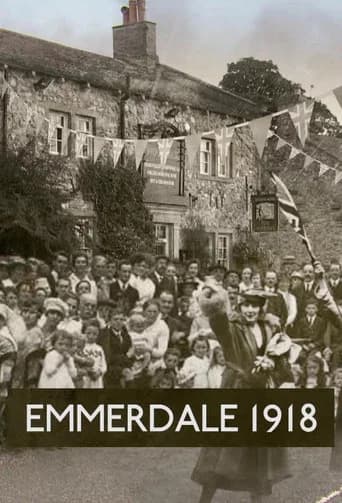
Emmerdale 1918
2018