Loading...
Loading...


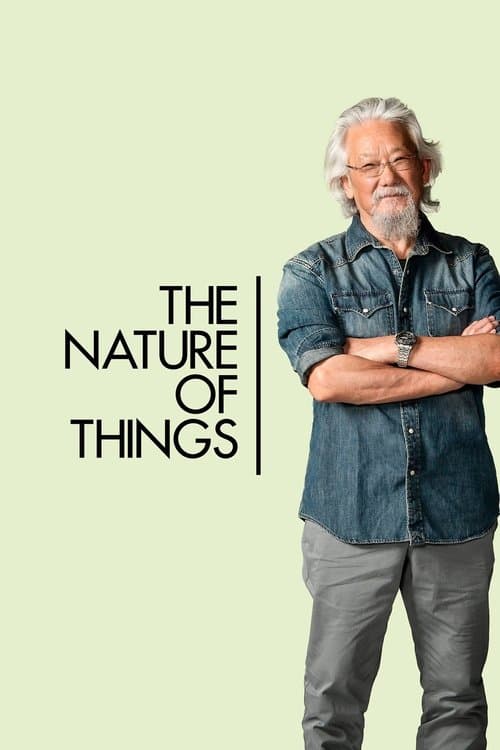
The Nature of Things is a Canadian television series of documentary programs. It debuted on CBC Television on November 6, 1960. Many of the programs document nature and the effect that humans have on it. The program was one of the first to explore environmental issues, such as clear-cut logging. The series is named after an epic poem by Roman philosopher Lucretius: "Dē Rērum Nātūrā" — On the Nature of Things.
1960
Study of brain cells, how research has helped the understanding of learning and memory. Filmed at the Montreal Neurological Institute, with Dr. Wilder Penfield and Dr. Herbert Jasper
Professor Donald Ivey probes the attitudes and working habits of scientists
Dr. John Zubec of the University of Manitoba explains his experiments and studies on boredom and its effects on the human mind
1963
Series consultant Lister Sinclair is host on season's opener on which he explains how scientists approach their work and how The Nature of Things will present scientific items.
British psychaitrist Dr William Sargeant discusses and illustrates various brainwashing techniques such as weakening of mind.
Hosts Dr Patterson Hume and Dr Donald Ivey of University of Toronto talk about electronics age brought about by vacuum tube and transistor.
Palaeontologist Dr Alfred S. Romer of Harvard University explains evolution of lungs, legs, and a new kind of egg in aquatic creatures.
Dr Fred H. Knelman of Montreal, talks about sources and chemistry of salt and industrial applications of salt and its components.
Film of an ear operation from BBC series YOUR LIFE IN THEIR HANDS, with commentary by Dr Hugh Barber, Toronto ear specialist.
Professors Donald Ivey and Patterson Hume demonstrate principles behind bounce in a rubber ball.
This program examines autonomic nervous system, how it works, and what it can reveal.
In cooperation with National Cancer Institute and Canadian Cancer Society, today's show explores results of years of lung-cancer research in Britain and North America.
To commemorate the Canadian Centennial in 1967 it has been proposed that Canada build a national museum of science. The program includes filmed demonstrations of how science and technology can be made meaningful to the general public.
Recent fossil discoveries in Africa have shed new light on the ancestry and evolution of man. Guest Dr. L.S.B. Leakey, renowned British anthropologist and paleontologist, unearthed fossil remains in the Olduvai Gorge that have extended the time scale of human evolution from 500,000 to two million years or more. A deductive story in anthropology and paleontology is told as Dr. Leakey describes his finds and interprets their significance
Series consultant Lister Sinclair pays tribute to Sir Isaac Newton. The program attempts to capture the spirit of the time through the words of Newton himself and those of his contemporaries
What happens in a car crash - to car and to its occupants? What causes a crash?
Hosts Dr Donald Ivey and Dr Patterson Hume of University of Toronto, contrast observation to synthesis.
Dr Louis Siminovitch, Professor of Medical Biophysics at University of Toronto, discusses what is currently known about heredity.
Baking bread may be a familiar process, but it is by no means a simple one. A very great number of fundamental chemical actions are demonstrated in baking of one loaf of bread
Detection of heatwaves by Special infra-red receptors has many industrial, military and other uses.
In aftermath of industrial revolution, with scientific advances offsetting human control, human species has experienced an increase so explosive that grave doubts are now held about future food supply.
1964
An examination of personality and achievement of Albert Einstein. Dr Jacob Bronowski of Salk Institute for Advanced Biological Studies at La Jolla, California.
Scientist and broadcaster William Whitehead and Dr WE Swinton, Director of Royal Ontario Museum discuss how size differences in animal kingdom are result of their environment and their habits.
Universal standards of measurements are explained in laymen's terms by Dr Patterson Hume and Dr Donald Ivey of University of Toronto.
Centuries ago, people in warmer parts of earth believed a dread disease was contracted from unhealthy air generated in swamps.
This program shows surgical techniques used in a new treatment for Parkinson's Disease.
Host Lister Sinclair and guest Lloyd Percival, sports authority, discuss and demonstrate how various sporting activities can now be precisely measured and how they can thus be improved.
Dr Patterson Hume and Dr Donald Ivey explain recent developments of laser beam since 1960, how it works, and its potential uses in medicine, war and communications.
Man still carries around in him an isolated pool of early Palaeozoic ocean that fed his plankton ancestors.
Host and writer Lister Sinclair talks about map projection, and problems of taking a spherical object, earth.
In this program Donald Crowdis, Director of Nova Scotia Museum of Science, talks about water.
In this program Donald Crowdis, Director of Nova Scotia Museum of Science, talks about transplants and new study of immunology.
1967
"Retreat to the Rockies" with an especial look at bighorn sheep.
A study of the rare and beautiful trumpeter swan, which was nearly extinct but has now returned to a reasonably healthy population of about 2,000 through efforts of federal and provincial conservation agencies.
The authentic sights and sounds of wildlife activity in the Arctic during the summer. Animals seen include polar bears and seals.
Wildlife in Alberta is the subject of tonight's episode. John Livingston narrates this final program in the special, four-part Centennial series about Canadian wildlife.
1965
The problem of survival in extreme climatic conditions is examined by Dr. William Whitehead.
Discussion and demonstration of "accidental" scientific discoveries.[37]
Lister Sinclair looks at the artificial flight techniques of man and some of the principles of flying used by other species.
Professors Patterson Hume and Donald Ivey dispute Mark Twain's claim that: "There are lies, damn lies and statistics"; or in other words, "you can prove anything with statistics."
Dr. Walter Clark of the Eastman-Kodak Research Laboratory, and host Lester Sinclair explain what happens after you push the button of your camera.
At one time, collisions between aircraft and birds usually hurt only the birds. Now, with aircraft flying at supersonic speeds, the impact of collisions is greater. And birds ingested into the engines have caused a number of crashes. The Nature of Things looks at what is being done to eliminate bird strikes on aircraft.
For the first time ever on television, part of the remarkable "pacemaker" heart operation is shown being performed at the Toronto General Hospital.
1968
Thomas Edison wasn't merely a lone inventful genius. He invented modern research team makes possible technology shaping our world.
A review of history of man's oldest materials: wood, stone, iron, bronze and glass.
Defying force of gravity, man has strewn his structures across earth. This program looks at some of them.
Much of this program deals with basic communications problem of getting a signal through noise.
The great engineers of past - men like DE Lesseps of Suez fame and Panama infamy and Bradley - whose canals were arteries of industrial revolution, sacrificed health and fortune, and sometimes lives.
One test of civilization is ability to organize sources of energy. Central power was something new in 1876.
The Greek inventor, Alexander Hero, first defined five basic devices which make all machines possible: lever, wedge, wheel, pulley and screw.
This program shows how man changes his environment by shaping land he lives on, reclaiming land from sea, making new lakes and rivers.
This film looks, sometimes whimsically, at examples of old and modern flying machines.
Man's first "portable power" device was part of his own body, energy from contraction of long molecules in presence of sugar: muscle power.
Are problems of urban transportation insurmountable? The traffic jams which are a regular feature of city life make it appear so.
A system, according to Oxford dictionary, is a whole composed of parts in orderly arrangement, according to some scheme or plan.
A study of life and work of Jean Jacques Audubon, great painter-naturalist who captured beauty of American wildlife on canvas.
1965
A series studying animal kingdom, and man's place in it, through comparisons of anatomy, function, and behavior.
How animals get from place to place, including burrowing, crawling, climbing trees, running,.
"Animals In The Water" studies fish, crocodiles, seals and whales.
A look at how animals have developed special means of coping with environments - long neck of giraffe, coat of polar bear.
A look at process of natural selection by which animals have developed special means of coping with their environments: long neck of giraffe, coat of polar bear.
How animals locate, obtain, process and eat food using "anatomical tools": beaks, claws etc.
Animals modify their environments in many ways: by building nests, damming streams.
Program shows how animals modify their environments in many ways; by building nests.
Man is known as "toolmaker", although certain other animals do use tools.
Different combinations of senses are dominant in activities of different animals: vision and smell in insects, smell and hearing in most mammals, vision and touch in higher primates.
A look at various ways animals and man defend their homes and their young.
How much of animal behavior is inherent, and how much is learned?
Man, animal species, as he might be described by an objective zoologist from another planet: what is he.
1971
Season opener: The Nature of Things looks at discovery of insulin by Dr Frederick Banting and Dr Charles Best and deals with current Canadian research into diabetes.
Chances of recovery by a cancer patient in Canada are examined. Guests: Dr James Till, Toronto's Princess Margaret Hospital, and Dr Robert Taylor of National Cancer Institute.
A look at research which may bring hope to sufferers of a crippling disorder that affects those on the older side of the generation gap. Guests include Dr. Oleh Hornykiewicz, a pioneer in the discovery of the drug L-DOPA.
A look at the endangered species of animals used in the fur trade, focusing on the Canadian market
The life history of the seal, currently the object of the great spring seal hunt; the physiology and behavior of this unusual Arctic animal, plus an examination of its 8,000-mile migration from Hudson Strait to the Gulf of St. Lawrence and back. Also a look at the seal's unique adaptation for deep diving, currently under study by biologists at the University of Guelph in Ontario
The world of the colorful bird family admired by hunters and birdwatchers alike.
Pictorial life history of the Arctic animals throughout the seasons.
A glimpse into the world of an unusual and amusing ocean inhabitant.
Documentary look at the Yanomami, a fast-vanishing Indian tribe inhabiting the tropical rainforest of the Upper Orinoco River in southeastern Venezuela and Northern Brazil.[
A visit to a deep network of underwater caves found offshore from the island of Andros, with Dr. George Benjamin, a Canadian research chemist and the world's foremost authority on the Bahamas' "blue holes" (underwater caves)
1970
The first in a four-part series entitled The Last Stand. The series looks at a variety of areas in the world set aside as specially protected areas of wilderness and natural wildlife. The first program is about western mountain parks and the work being done by biologists and scientists to save mountain wildlife.
The Everglades, unique in the world, are dependent entirely on water. But the beautiful birds and animals in the park are threatened by land development and a new airport, whose drainage policies are drying up the area.
The third in a four-part series entitled "The Last Stand." Point Pelee is a tiny peninsula in southwestern Ontario, jutting into Lake Erie, which contains a fresh water marsh full of wildlife of all kinds. It is also the last stronghold of the southern deciduous forest in Canada and contains southern species of plants and animals not found anywhere else in the country.
The last in a four-part series entitled The Last Stand. This program looks at Sonoran Desert in US Southwest and in Mexico.
The first in a three-part series entitled "A Sense of Time". This examines past and present ideas on questions of how old is universe.
This program focuses on a new geophysical concept of our planet.
Planet Earth has supported life for some three billion years; but Man, characterized by his powers of thought and other other intelligent faculties, has shown greatest development.
Sociologists tell us that Great Lakes are basis for civilization around them. If lakes fail.
Immediate implementation of pollution control in our Great Lakes is urgently needed if we are to preserve our most vital waterway.
Population: Everybody's Baby" examines projected consequences of overpopulation and-controversy surrounding population control.
Featuring a national opinion poll on public attitudes in Canada towards population growth.
Dealing with McGill University Settlement Mental Health Unit project in Montreal..
Psychiatry: Heavy Night
A visit to Montreal's Allan Memorial Institute, where a disturbed teenager responds to treatment.
A look at Vancouver-area encounter groups.
1975
Season Debut: A two-part film about the ease in which little children learn languages.
Severely deaf children learn to speak like normal children with the aid of powerfully sensitive hearing aids and teaching techniques being used by dedicated teachers.
A look at Sable Island, about 100 miles off Nova Scotia, where the wildlife has had an unusual evolution because it is separated from the mainland.
Unique life forms in a pond.
Visible and microscopic life at the edge of a pond.
Documentary on prairie dogs and one colony in particular in South Dakota.
The fruit fly is used as the focus for a discussion of mutations, current genetic research and the relationship of this research to some of the problems suffered by humans.
The program shows how psychological experiments support those who believe that community and citizen control over their own environment is essential to the well being of city dwellers.
1976
The work of a group of naturalists who are attempting to create a refuge for biblical animals by restocking a park with species inhabited land in Bible times.
Through the use of micro-photography, viewers are afforded a look at the unique way in which a reef is formed through a complex system of natural recycling.
A study of the capabilities that are innate to a newborn baby in the first week after birth.
A look at the work of scientists who are exploring regions of the brain by examining its relationship to the visual system.
A study of the Todos tribe of India, their polyandrous marriage rituals and their unusual funeral rites. The Todos spend their lives tending the buffalo and everything they do revolves around this animal.
The Gabra is a tribe of 24,000 people who live in the harsh terrain on both sides of the Kenya-Ethiopia border. They may be the only non-Muslim, camel raising society left in the world. Their lifestyle is cruel, filled with age-old rituals and beliefs.
A look at the uses man has made of the wind, from sailboats to windmills to modern turbines for generating electricity.
Shows some of the species of seabirds to be found on Funk Island, situated 40 miles east of Newfoundland, which is a breeding ground of more than one million seabirds, and stresses the need for their protection against man.
Streaming availability information not available
1978
Season premiere: Anthropologist Richard Leakey discusses his work in Africa, and explains the latest techniques by which scientists measure time and age of subjects.
The phenomenon of man's changing concepts of the world is explored in relation to his desire to measure time more accurately.
A series of people of varying ages, professions and experiences express their innermost feelings on subjects ranging from dateless Saturday nights to fear of death.
A study of individual development and group dynamics in a troop of rhesus monkeys in the natural observable environment of Cayo Santiago near Puerto Rico.
The cliff-dwelling Dogon farmers and their unique culture are studied in their homeland near the Niger River in Mali.[261]
The current efforts in both the United States and Canada to harness the sun as a major resource of heat and power are examined.
The activities of the economic and social center of Sololá, located on Lake Atitlán in Guatemala, are viewed.[263]
Volunteers undergo an experiment at the Montefiore Sleep Lab in New York which monitors their sleeping-awakening cycles in an attempt to learn more about the body's biological time system.[264]
Analysis of dreams is viewed at several institutions established expressly for that purpose, and those who participate in the experiments are shown as they make notations and give recollections of what they dreamed.
Canadian paleontologist Charlie Sternberg and his work in cataloguing dinosaur fossils in the Albertan Badlands are profiled.
The Search follows World Health Organization medical teams on their campaign to vaccinate the against smallpox in Somalia, the world's last location where the disease survives.
The descendants of Nova Scotia's Acadians and their lifestyle are profiled at their adopted home, the Bayou Lafourche in southern Louisiana.
1999
We've all felt the terror of being lost - even for just a few moments. We lose our way; a child unexpectedly vanishes in the aisles of a supermarket.
How much are children influenced by their peers? The documentary Do Parents Matter? examines a controversial concept put forth by Judy Harris, a suburban grandmother and author of the explosive book, The Nurture Assumption.
The Birth of The Human Mind takes viewers on an amazing journey back in time, exploring the use of language, tools and how our distant ancestors came to walk. Contrary to long-accepted belief, scientists now believe that Homo sapiens did not evolve from Neanderthals, but shared the earth with them for thousands of years. Our ancestors, the Homo sapiens, are the youngest members on the human family tree, about 150,000 years old. Homo erectus goes back 1.8 million years and Neanderthals about 200,000 years.
Paleoanthropologists, linguists, archeologists and other scientists offer the latest interpretations of fossil findings and genetic studies and posit intriguing theories on how Homo sapiens became the only existing human species. Did we kill off our cousins, interbreed and merge with them, or did they just die out? It took five million years for an upright ape to evolve into an agile, quick-thinking and inventive human being. But once our ancestors emerged in Africa, were we destined to dominate the globe?
The nature of weather is so complex that it is really a system of chaos. Weather is often benign, but occasionally the chaos spawns fierce dragons. Severe weather - violent storms, floods and droughts - is largely beyond human control, and can be cruel. Few need reminding of the 1987 tornado that killed 27 people in Edmonton, the flooding of the Saguenay region in 1996 and the Red River in 1997, and the 1998 ice storm in Quebec.
2007
Canadian bear expert Charlie Russell rescues two orphaned cubs destined for death in a squalid Russian zoo and secrets them away to his home in the remote wilds of the South Kamchatka peninsula, in the former Soviet Union.
Explorer the ongoing quest to extend human life, the cutting-edge research and the latest discoveries.
Climate change is irrevocably altering the world as we know it, challenging our sense of the future and the fundamental values of our industrial societies.
Explore the impact of both colonial and contemporary initiatives in Kenya and how they affect the peoples who have traditionally lived off the land.
The emerging world market in living cells, where an individual's genes can be bought and sold as commodities.
Witness the exciting lead up to the launch of the new High Speed One service out of St. Pancras Station, in London. A look at the Large Hadron Collider, the largest and most sophisticated machine ever constructed by science. And an interview with musician and environmentalist, Sarah Harmer.
Now that climate change is an accepted, if inconvenient, truth, how are we coping? David Suzuki takes a first-hand look at how climate change is affecting Canadians where it really hurts: in their ability to make a living.
Hot Times in the City takes the pulse of three major Canadian cities: Vancouver, Toronto and Halifax, as they grapple with one of the planet's greatest threats to human health: global warming.
A look into the multi-billion dollar underworld of counterfeit drugs, the tale of the Lunokhod a self-propelled robot on the Moon that could be controlled from the Earth and an interview with Boston Bruins' defenseman, Andrew Ference.
In Hearing, episode one of The Science of the Senses, finding the answer to that question will take us on a journey through the ear, into the brain and right into the heart of the human psyche.
In The Science of the Senses: Touch we will take a journey through the skin, into the subcutaneous world of our sensory receptors and up into the brain as we explore the hidden language of our most essential sense.
In this episode of The Science of the Senses, we explore how smell combines with taste, somewhere in our brain, to create the perception of flavour. Most people wrongly assume that taste dominates. But what actually allows us to differentiate one food from another beyond the basics of sweet, sour, salty, savory and bitter, is the aroma.
This episode takes viewers on a fascinating tour of our visual world, from the moment light enters our eyes, to the way this information is transformed into electrical impulses and decoded by our brain - the domain of "visual perception". The act of "seeing" takes an immense amount of brainpower, more than 65% of the brain's neural pathways.
Explores how China's 1.3 billion people interact with their extraordinary wildlife and landscapes.
Beneath billowing clouds in China's far southwest, rich jungles nestle below towering peaks and jewel-coloured birds and ancient tribes share forested valleys where wild elephants still roam.
Explore the vast windswept wilderness in one of the world's most remote places - the size of Western Europe.
Travel across China's heartland where its Han people are the centre of a 5,000-year-old civilization.
Warrior nomads, bizarre wildlife and extreme weather conditions are found beyond the Wall, built by China's emperors.
China's coast is an area of huge contrast-from futuristic modern cities jostling traditional seaweed-thatched villages to ancient tea terraces and wild wetlands where rare animals still survive.
The SEDNA IV sails across the Polar Front, an area where cold turbulent Antarctic waters meet warmer water from the north - one of the earth's last great refuges for wildlife.
Antarctica's inhabitants are telling us that their world is changing in complex and subtle ways. The once successful colonies of diminutive Adelie penguins are declining because of increased snowfall - one of the unexpected consequences of a warmer climate.
A cold and mysterious world that is home to some of the toughest and most unusual creatures on the planet: giant ribbon worms, dragon fish, and ancient sponges.
Follow mission leader Jean Lemire and his crew as they endure 17 months on the expedition to measure the threat posed by global warming in the Antarctic - a place where the Earth is particularly vulnerable.
1974
A documentary showing the behaviour of killer whales in the wild, in the waters off Vancouver Island.[194]
Story of a child's stay in Toronto's Hospital for Sick Children.
A film on volcanic eruption off south coast of Iceland in 1973.
An ancient Egyptian mummy rests at Pennsylvania University Museum far from where she had been prepared to spend eternity .
What happens when a person makes a voluntary movement? Some say human behavior is involuntary.
Frogs, snakes and turtles play vital roles as janitors and regulators of the environment.
An archeological party discovers evidence that an old Hudson's Bay site at the foot of James Bay had been burned down by the French in the 17th century.
What goes on in the very top layer of the Earth's soil is often too small to see with the naked eye. When photographed under a microscope, that first inch of soil reveals itself to be one of the most vital of the life cycles affecting man.
2012
Wolves and Buffalo follows the fortunes of one pack of wolves, the Delta Pack. Will the pups survive their first year? Will the packs alpha animals retain their pack position to breed again next year? As they try to bring down the buffalo to keep themselves and their new pups alive what will the future hold for these ancient warriors?
There are those of us who see squirrels as cute and fascinating, but there is also a large contingent who regard them as “tree rats” - little pests that never tire of wreaking havoc in our attics, gardens, and just about anything else that catches their fleeting fancy. So who’s right? Nuts about Squirrels reveals the secret world of the ubiquitous urban grey squirrel with squirrel robots, micro-chipped acorns and an army of citizen scientists.
Are we alone in the universe? We may be very close to finding out. For millennia humans studying the stars had no idea if there were any other planets in the universe, let alone ones similar enough to ours to sustain life. Now, scientists may be close to discovering Earth-like planets, using a new space telescope and a technique pioneered by two Canadian astronomers.
Twelve hours of light. Twelve hours of dark. For our entire history we have lived and worked in rhythm with the sun. But all that changed with the invention of artificial light. Light fixtures, computer and television screens - all of these have allowed us more time to live, work, play and shorten our nights. But at what cost? Are we putting our health at risk? We explore how the type of light we are exposed to in the hours between dusk and bedtime can play tricks on our bodies and cancel the healthful benefits naturally triggered by the absence of light.
People struggle to combat a blood-sucking little insect that is both delicate and deadly.
There is a new hybrid species which is part wolf, part coyote.
The exotic world of fruit and the story of nature, commerce and obsession.
The conservation of the caribou and their environment is much-contested territory.
The national symbol has a new role as an ecological superhero.
Through pictures, music and poetry, Canadian Commander Chris Hadfield brings us a view of earth from space that we’ve never seen before.